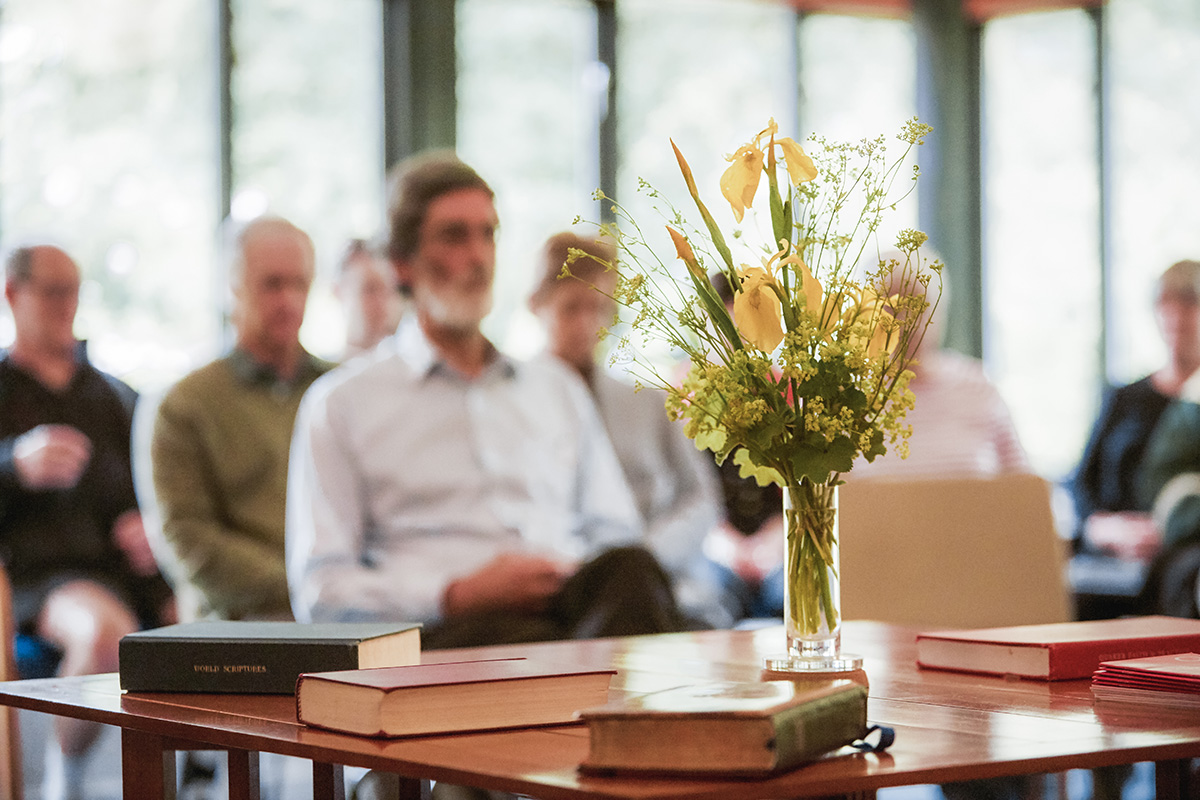
Quakers welcome newcomers and are careful not to try too hard to encourage you to return, although of course we all hope that visitors will become regular attenders, and in time feel moved to apply for membership.
Your first time at a Quaker meeting...
They may only be ready to hold an awareness that their experiences in life point beyond themselves to a greater whole. Some will thankfully accept God’s inexhaustible love shown in Jesus, the promise of forgiveness and the setting aside of past failure. Others will know their direction is a seeking to be open towards people in a spirit of love and trust.
In the quietness of a Quaker meeting worshippers can become aware of a deep and powerful spirit of love and truth, transcending their ordinary experience. We seek to become united in love and strengthened in truth, so we enter a new level of living, despite the different ways we may account for this life-expanding experience.
After about an hour, two people (usually called elders) may shake hands to mark the end of the worship. The clerk may then announce forthcoming events and give news of members. Afterwards, do feel free to speak to anyone, particularly if you wish to know more about Quakers. Literature is usually available and books can often be borrowed.

Robert Barclay (1648–1690), who wrote the first systematic exposition of Quaker theology, shows how knowledge comes from worship:
Not by strength of arguments or by a particular disquisition of each doctrine, and convincement of my understanding thereby, came [I] to receive and bear witness of the Truth, but by being secretly reached by [the] Life. For, when I came into the silent assemblies of God’s people, I felt a secret power among them, which touched my heart; and as I gave way unto it I found the evil weakening in me and the good raised up; and so I became thus knit and united unto them, hungering more and more after the increase of this power and life whereby I might feel myself perfectly redeemed; and indeed this is the surest way to become a Christian; to whom afterwards the knowledge and understanding of principles will not be wanting, but will grow up so much as is needful as the natural fruit of this good root, and such a knowledge will not be barren nor unfruitful.
(QF&P 19.21)